| back to contents | ||||||
 |
||||||
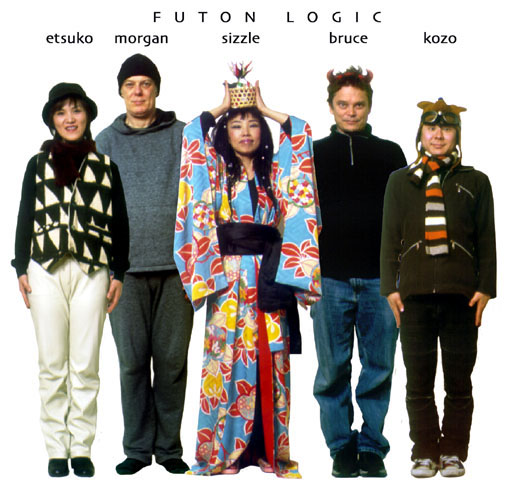
| Photo by Bruce Osborn. | ||||||
| Futon Logic began with singer Sizzle Ohtaka’s brilliant idea to bring together several friends (both musicians and graphic artists) she had worked with separately in the past. Their first performance was in August 2002, and slowly but surely, word is getting round that this is a unique and fascinating creative unit. From radical dance to gagaku, from kimonos to digicams, Futon Logic express with depth and humour, with atmosphere and rhythm, the multi-dimensional 21st century life the members experience in Tokyo today. All the members of this unit have travelled and performed extensively throughout the world. All come from remarkably different backgrounds, and the result is a rich brew – one that can incorporate the most avant of the avant-garde into a musical and visual experience that is joyful and positive enough for all kinds of audiences.To see news and performance information please go to the Futon Logic website or Morgan’s Live Information page.
You probably know Morgan by now, so let’s take a look at the other members: Singer Sizzle Ohtaka was born in Tokyo, Japan, and brought up in a strongly traditional Japanese music environment. Later she studied western classical singing and then became influenced by various types of music including jazz and world music. She was especially inspired by the Egyptian oud master Hamza El Din, who was until recently a resident of Japan (and recorded an album with her and Morgan). Sizzle Ohtaka crosses musical genres: traditional Japanese, new age, world, experimental, improvising. In Japan she is variously characterised as "Non-genre, Organic Avant-Garde, Neo-Antique." Her voice has remarkable overtones which were common in Japan before the recording era, but can rarely be heard these days; it is described as a rainbow voice – a voice of many colours. Her extraordinarily versatile singing has been featured in over 500 radio and TV commercial songs. With her uniquely contemporary kimono-based fashions, she brings colour, humour and elegance to the stage. Etsuko Takezawa is an acknowledged pioneer in the contemporary use of the traditional Japanese instruments koto, shamisen and sho. After intense study with three of Japan’s most respected masters of the koto, her career expanded rapidly to include worldwide performances of works by John Cage, Terry Riley, Toshi Ichiyanagi and Harry Partch. She has also performed with rock bands, noise artists (Yoshihide Otomo) and jazz improvisers (John Zorn). Her four-koto ensemble Koto Vortex (who appeared on Morgan’s "Miniatures 2" album) astonished listeners not only with their specially-commissioned works by composers such as the legendary Moondog, but also with their live shows where they replaced the standard kimonos with punk-style leather outfits. Etsuko is now established as a teacher of the koto at one of Japan’s leading music conservatories. Photographer Bruce Osborn, like Morgan, is one of Tokyo’s longest-established creative ex-patriots. He moved to Tokyo in 1980 and quickly made a name for himself as a witty, intelligent photographer with a keen eye for the street life in this extraordinary metropolis. Rapidly building up a large circle of unusual friends in all walks of life, he decided to photograph them as parent/child duos for his hugely popular book "Oyako" ("Parents & Children"), followed by "Kazoku" ("Family"). Subjects ranged from Yokoo Tadanori (Japan’s leading modern painter) and Hiroshi Teshigawara (master of the Sogetsu flower school) to an unknown soft-porn actress. He became in demand as a designer of CD jackets, and later moved into video and attracted international commissions from commercial TV and artistic organisations, and in recent years began video performances with musicians such as Sizzle Ohtaka. He was the natural choice as director of the visual aspect of Futon Logic’s performances. Computer graphics artist Kozo Chiba developed his artistic outlook at a very young age: his father Tetsuya Chiba is one of Japan’s most popular and well-loved "manga" (comic book) writers, whose works touch the hearts of millions through stories related to sumo, sports heroes and schoolboy characters. Kozo has adopted digital video technology to express his young, quintessentially modern Japanese outlook, and has already had vast experience in the world of High-Definition Television as well as design work for album jackets, video games and "anime." Like many forward-looking graphic artists he is keen to bring his work to a live audience (using laptop computers rather than video decks), and his collaboration with Bruce Osborn results in a multi-layered collage-based video style. Morgan’s multifarious music making fits right in with this wonderfully complex combo – watch out for Futon Logic on stage, on CD, on DVD, and on this website. |
||||||